What is Theory of Change?
Theory of Change is a monitoring and evaluation approach. It was developed by evaluation theorists and practitioners, most notably Carol Weiss. Like other theory-driven approaches to evaluation, Theory of Change posits that you have to understand how and why an intervention, program or policy is likely to work. Theory of Change can be used to evaluate interventions, policies and programs but can also be used before an intervention is developed to plan the intervention.
Theory of Change has been used widely in the development sector and the evaluation of community-level interventions. It is increasingly being used in the health and social care sector as foundation to understand how and why an intervention might work.
What other approaches are similar?
Theory of Change is very similar to other tools such as program logic, logic models and logframes which often list impacts, outcomes, outputs, activities and resources. However, Theory of Change goes deeper to understand why the activities might lead to specific outcomes.
Can you give me a simple example?
Sure, in this simple Theory of Change we explore how someone wants to be connected to their friends. You can see the red box describes what we ultimately want to achieved (the impact). The yellow boxes describe what needs to change for us to get to the red box. These are referred to as outcomes. The grey boxes tell us what we need to do to make this happen (activities). This allows others to look at how you think your project/program/policy is going to work and whether it is likely to work.
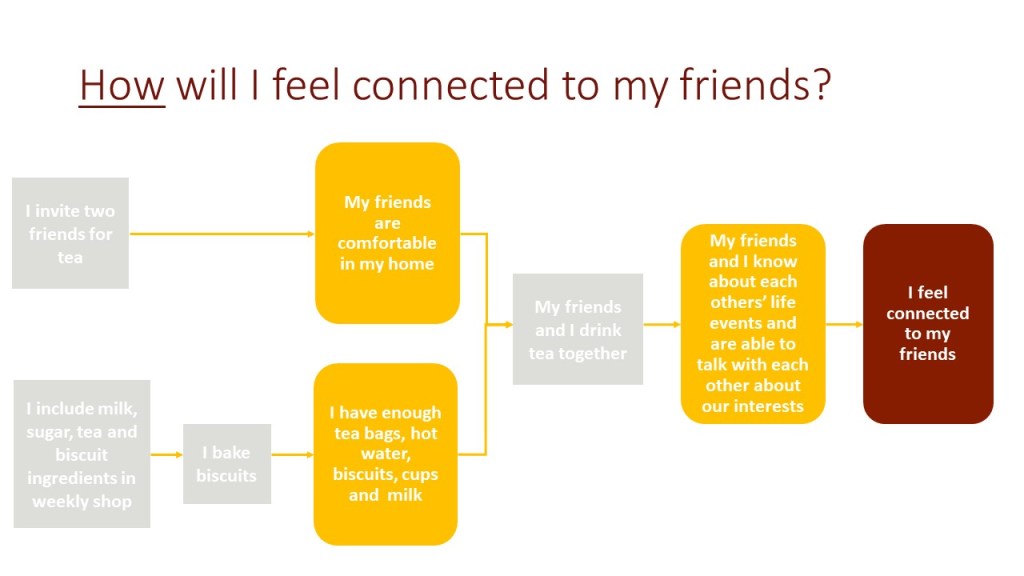
Theories of change often also describe how we know these changes are going to happen (rationale), how we know whether they did happen (indicators) and under what conditions this would happen (assumptions).
This is a really simple example but you can see how it clarifies what needs to happen in a really logical and transparent way. Interventions/programs and policies in health and other areas are significantly more complex so understanding the Theory of Change underlying them is really important. You can have a look at a more complex example here.
How can it help my work?
Theory of Change is useful in any situation where you want to understand how to reach a specific impact or outcome. For example, you could develop a Theory of Change to understand how to increase adherence to HIV medication, how to integrate mental health into primary healthcare or how to increase gender parity in your organisation.
If you want to learn more, I am running an Introductory Course on Theory of Change from April-June 2024
 Erica Breuer